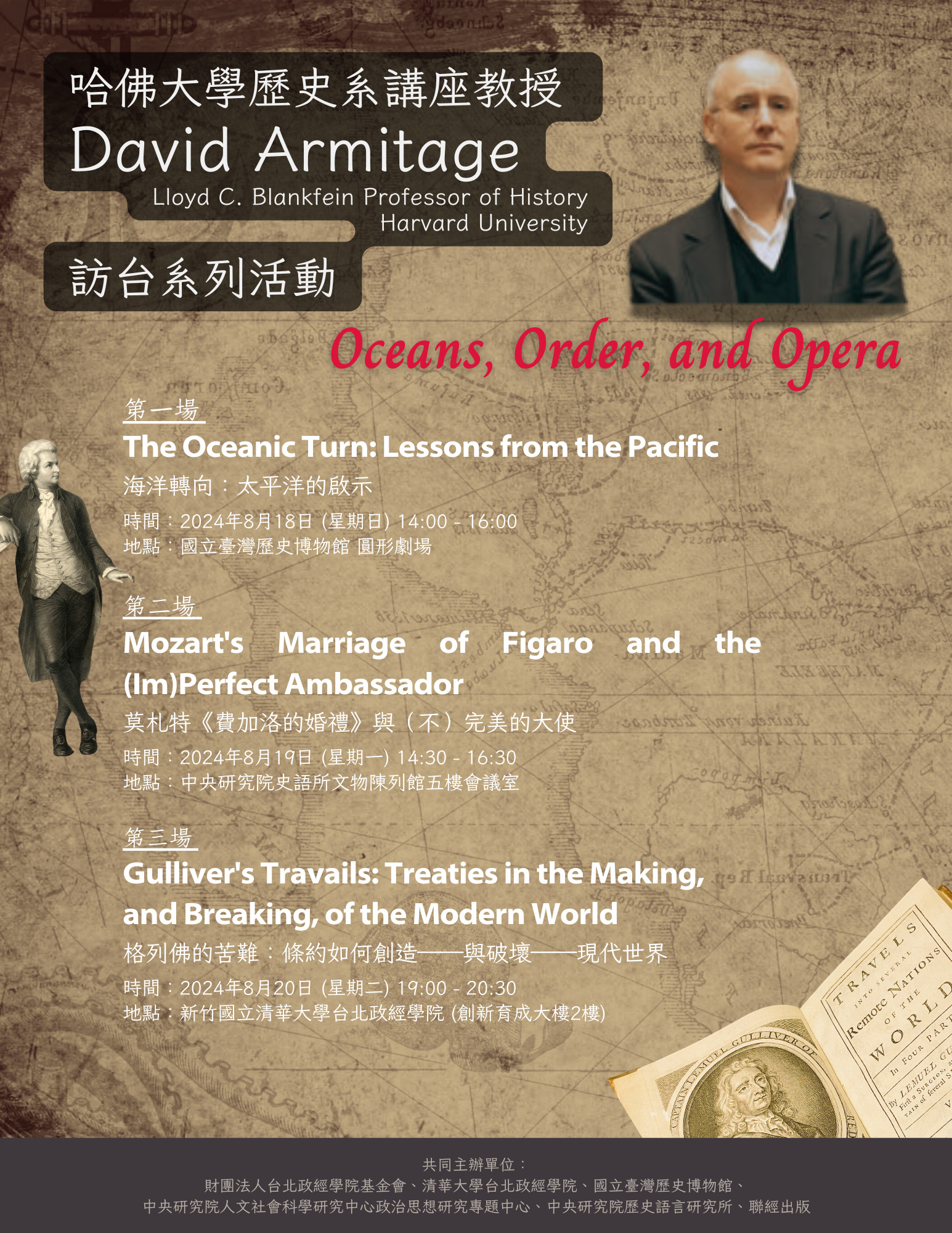
【公告】8/20(二)19:00-20:30 哈佛David Armitage講座《格列佛的苦難:條約如何創造—─與破壞—─現代世界》
台北政經學院誠摯邀請您參加哈佛大學歷史系講座教授大衛.阿米蒂
國立清華大學台北政經學院(TSE)非常榮幸邀請哈佛大學歷史系
8月20日(二)大衛.阿米蒂(David Armitage)將以《格列佛的苦難:條約如何創造——與破壞
活動詳情
【日期】2024年8月20日(二)
【時間】19:00-20:30
【地點】國立清華大學 台北政經學院 (新竹市東區光復路二段101號 創新育成大樓2樓)
【報名表單】Click here
【講座主題】 格列佛的苦難: 條約如何創造——與破壞——現代世界 (Gulliver’s Travails: Treaties in the Making, and Breaking, of the Modern World)
【主講】David Armitage (Lloyd C. Blankfein Professor of History, Harvard University)
國立清華大學台北政經學院
財團法人台北政經學院基金會 敬邀
Taipei School of Economics and Political Science (TSE) cordially invites you to a lecture by Professor David Armitage from Harvard University, titled "Gulliver’s Travails: Treaties in the Making, and Breaking, of the Modern World."
David Armitage, the Lloyd C. Blankfein Professor of History at Harvard University, is a distinguished historian. His research focuses on intellectual history and the history of political thought. Armitage is a leading figure in the field of global intellectual history and has recently ventured into maritime history.
In this lecture, Professor Armitage will explore the significance of treaties in modern world history. Using metaphors from Jonathan Swift's Gulliver's Travels, he will illustrate how treaties bind nations' actions. As the number of treaties has increased dramatically in contemporary society, they have had a profound impact on international affairs. Armitage will emphasize the importance of interdisciplinary research in comprehensively understanding the historical context of treaties to grasp the political, economic, and international dynamics of the modern world.
Event Details
【Date】 Tuesday, August 20, 2024
【Time】7:00 PM - 8:30 PM
【Venue】Taipei School of Economics and Political Science (101 Section 2, Kuang-Fu Road,
Hsinchu Innovation and Incubation Hall 2nd floor)
【Sign up】Click here
【Lecture Topic】Gulliver’s Travails: Treaties in the Making, and Breaking, of the Modern World
【Keynote speaker】 David Armitage (Lloyd C. Blankfein Professor of History, Harvard University)
Yours sincerely,
Taipei School of Economics and Political Science
National Tsing Hua University
&
The Taipei School of Economics and Political Science Foundation